
Here is a quick explanation of the different glues used to build model airplanes.
Ambroid cement is readily thinned and cleaned with acetone. It works well for gluing wood to wood and is somewhat flexible. Joints can be softened for repairs at a later date. Sands well during finishing if not globbed on. This is a waterproof glue. Seldom used by modelers today, it can be purchased from boat building suppliers.
Yellow woodworker's or aliphatic glue, available from most craft and hardware stores. Thin this with 25-40% water. It holds well for gluing wood and tissue, but will take hours or overnight to dry. Yellow glue is quite flexible depending on how much you thin it. It can be easily cut through with a sharp razor knife and sands well. This glue is water resistant but not waterproof and requires doping the surface to improve water resistance or for outdoor flying.
Instant glue known as CA or cyanoacrylate glue, comes in different viscosities and reacting speeds - thin, medium and thick, with cure times of 5 seconds to 2 minutes. Most model builders use CA glues. We use JET CA Glues. Applying this type of glue can be done via a small diameter tip on the end of a bottle allowing a tiny drop to be placed where you want it or by placing several drops on some plastic and dipping the end of the wood to be butt joined into the glue followed by putting the piece into it's location. The thin type of glue works best with the applicator tip, however the dipping method is better for the thicker glue. Thick cyanoacrylate glue is heavier but very strong, the joint is stiff, it does not sand easily, but it is waterproof. Jet SET accelerator can be sprayed where you have just finished applying the glue or by putting the glue on one piece and spraying accelerator on the other surface to be jointed. Make sure you are ready as the joint sets very quickly. Cyanoacrylate glue does not work for applying tissue.
Glue sticks. To apply tissue we use glue sticks which are a permanent glue which dries clear. Just spread it evenly along the wood, lay the dampened tissue on carefully and pull taut. Another option involves using thinned white glue. You paint this on the wood, then lay the dampened tissue in place. Finally seal and water proof the tissue. Clear Krylon spray paint is our choice for water proofing. It does a great job of sealing the tissue with minimal fumes.
Dope. Yet another technique is to paint several coats of dope on the frame. After it dries, damp tissue is laid in place and then dope is brushed on along the wood structure through the tissue. After the tissue dries seal it with several coats of dope. Dope can be purchased in colors or clear. Ventilation is mandatory when using dope.
Foam Safe CA Glue. For building models that contain foam parts UFO Odorless glue is the most effective. An added benefit is practically no fumes.
On a final note: Always remember to read the manufacturer's warning label and follow their instructions.
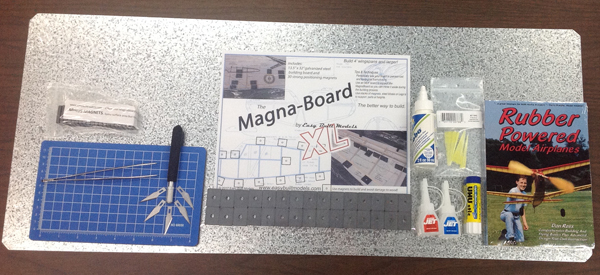
Building Set for Rubber Power
Includes a hobby knife, 5 blades, straight point tweezers, 5.5" x 9" Self Healing Cutting Mat, Jet Instant glue, Jet Super glue, Jet Tips, glue stick, canopy glue/tacky glue, MagnaBoard XL™ set, Minus Magnets 20 pack, and Rubber Powered Model Airplanes book. Save 25% off individually priced items! There is a limit of 2 sets per order.
item B329 Price: $79.95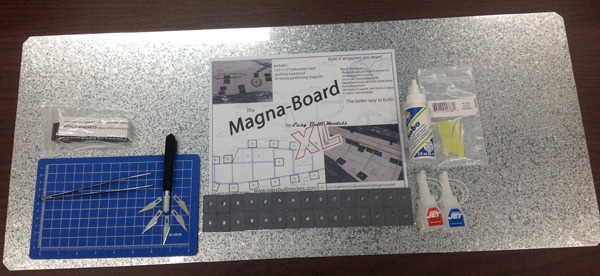
Building Set
Excludes the book on rubber power and the glue stick. Includes a hobby knife, 5 blades, straight point tweezers, 5.5" x 9" Self Healing Cutting Mat, Jet Instant glue, Jet Super glue, Jet Tips, canopy glue/tacky glue, MagnaBoard XL™ set, and Minus Magnets 20 pack. Save 25% off individually priced items! There is a limit of 2 sets per order.
item B332 Price: $66.95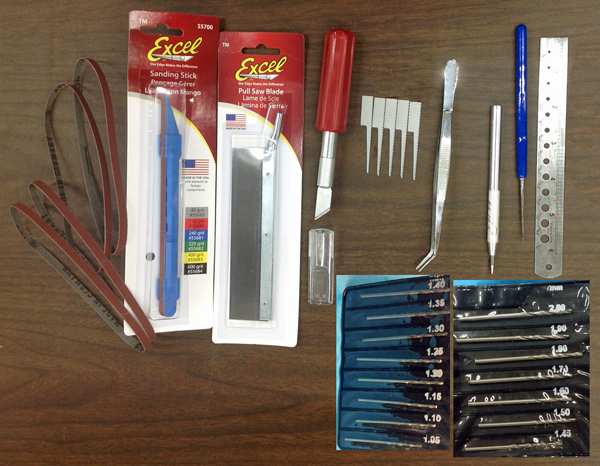
Advanced Tool Set
Includes Sanding Stick with 120, 240, 320, 400, and 600 grit belts, Pull Saw Blade, K5 Heavy Duty Knife with beveled blade, Narrow Keyhole Saw Blades 5 pack, Curved Tip Tweezers, 1/16" Ball Tip Burnisher, Jewelers Needle Point Awl, Steel Ruler 6" x 1" with drill gauge, 15 piece drill set (1.05mm - 2mm). Save 30% off individually priced items!
item B330 Price: $45.99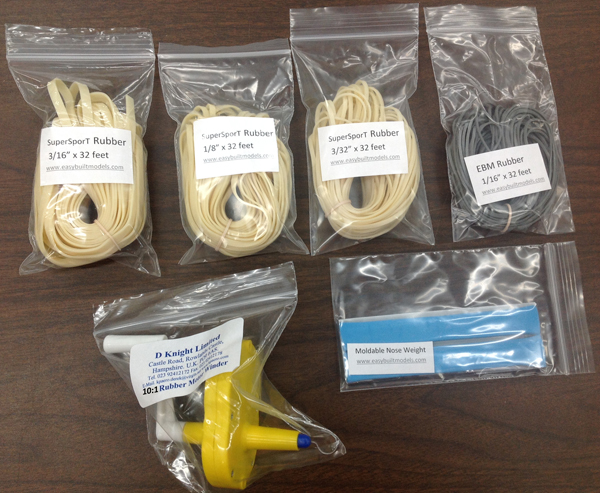
Flight Pack for Rubber Power
Includes a 10:1 winder, moldable nose weight, FAI SuperSport rubber 32 feet each 3/32", 1/8", and 3/16" and 32 feet EBM 1/16" rubber. Save 23% off individually priced items!
item B331 Price: $34.95